Clofenbria
Kills the eggs — the application that stops the mite population before it starts.
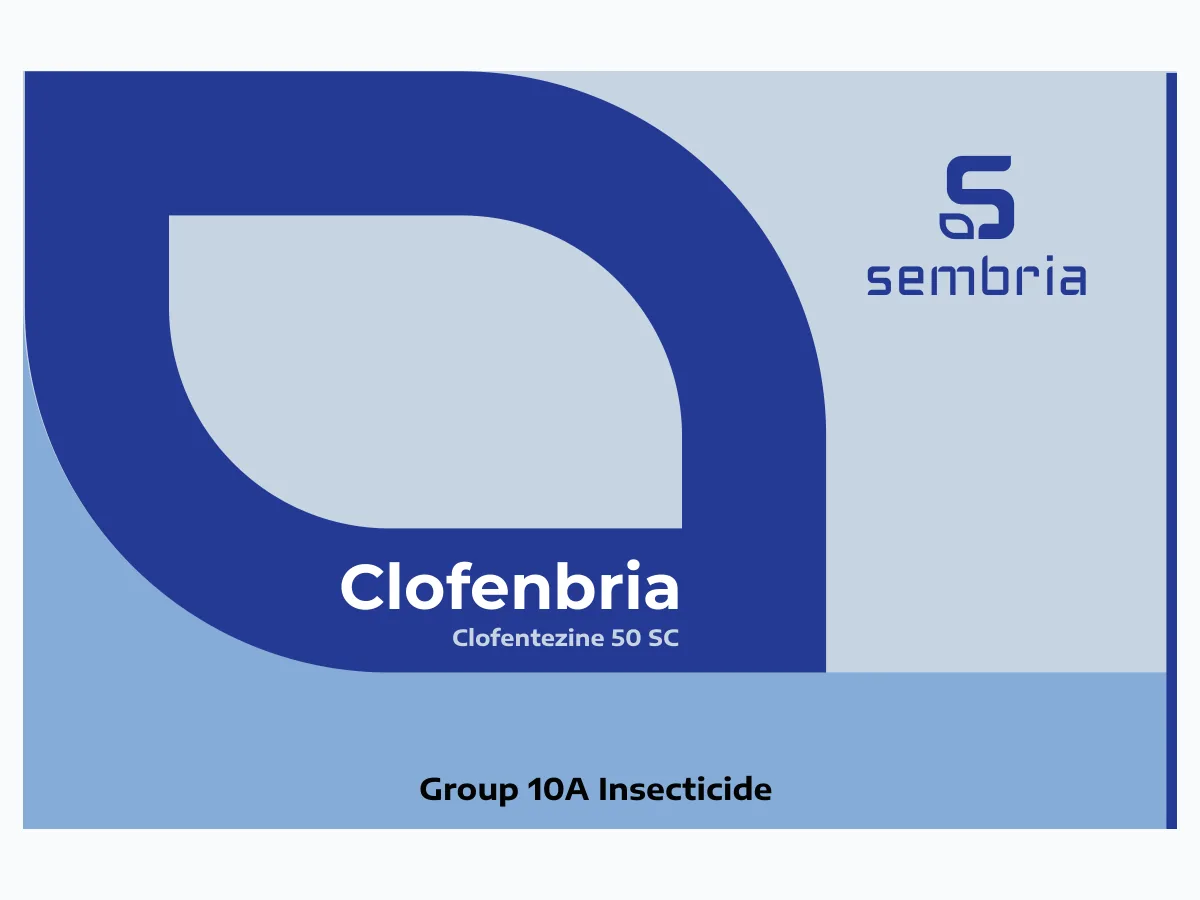
Clofenbria is a specialist acaricide based on clofentezine, and it works differently from every other mite product in the range: it targets eggs and the youngest motile stages rather than adults. Applied early, before the population builds, it prevents the generation that would otherwise cause the damage — and its long residual activity keeps working for weeks. It is the preventive half of a mite programme, best paired with an adulticide when populations are already established.
Characteristics
- Ovicidal — controls eggs and early motile stages, breaking the generation cycle
- Long residual activity from a single early application
- IRAC Group 10A — no cross-resistance with abamectin (6) or bifenazate (25)
- Three-day pre-harvest interval on apple, blackthorn and peach
- Four-year storage stability, the longest in the range
- Low rates: 20-40 ml/100 L water
How it works
Clofentezine inhibits mite growth by interfering with embryonic development and moulting. Eggs fail to hatch and young stages cannot complete their moult. Adults are largely unaffected, which is why timing matters: the product must go on before or at the very start of population build-up. IRAC Group 10A.
Dosing
| Crop | Target pest | Dose | PHI (days) |
|---|---|---|---|
| Apple | European red spider mite | 20 ml/100 L water | 3 |
| Apple | Two-spotted spider mite | 20 ml/100 L water | 3 |
| Blackthorn | Blackthorn mite | 20 ml/100 L water | 3 |
| Blackthorn | Two-spotted spider mite | 20 ml/100 L water | 3 |
| Cucumber / cornichon / eggplant | Red spider mites | 20 ml/100 L water | 3 |
| Beans | Red spider mites | 25 ml/100 L water | 3 |
| Peach | Two-spotted spider mite | 30 ml/100 L water | 3 |
| Cotton | Two-spotted spider mite | 40 ml/100 L water | 21 |
| Soybean | Red spider mite | 40 ml/ha | 30 |
Doses are indicative. The user is responsible for adjusting the dose to the growth stage of the crop and the conditions of the field. Apply under the guidance of an agricultural technician. Composition, method of application and dose may vary between countries for climatic, technical or legal reasons.
Application
How to apply
Peach: begin periodic leaf applications from early May and treat at an average of 8-10 live individuals per leaf, or 0.5 g of product per litre of water at 5-8 active individuals. Cucumber, cornichon and eggplant: treat at 5 live individuals per leaf; beans at 3. Cotton: inspect at the 4-6 leaf stage and spot-treat local infestations; treat at 5 live aphids per leaf in the Mediterranean zone, 10 in Aegean and Southeast Anatolia. Soybean: do not apply after pods have matured. For hectare applications use 75 L of water.
Compatibility
Always perform a compatibility test before mixing with other plant protection products.
Always carry out a compatibility test before preparing a tank mixture.
Safety and handling
No specific poisoning symptoms; may cause weakness or, in high amounts, eye and skin irritation. Keep out of reach of children and away from food and animal feed. Store locked up. Prevent entry of people and animals into the treated area.
Read the label before use. Do not use at home. Keep away from children, food and animal feed. Use only as recommended and at the recommended dose.
Plant protection product
This page is technical information, not an offer of sale. Availability and registration status vary by territory. Always read and follow the approved product label before use.