Chlorybria
The widest pest label in the range — scales, borers, aphids, soil pests and leafworms.
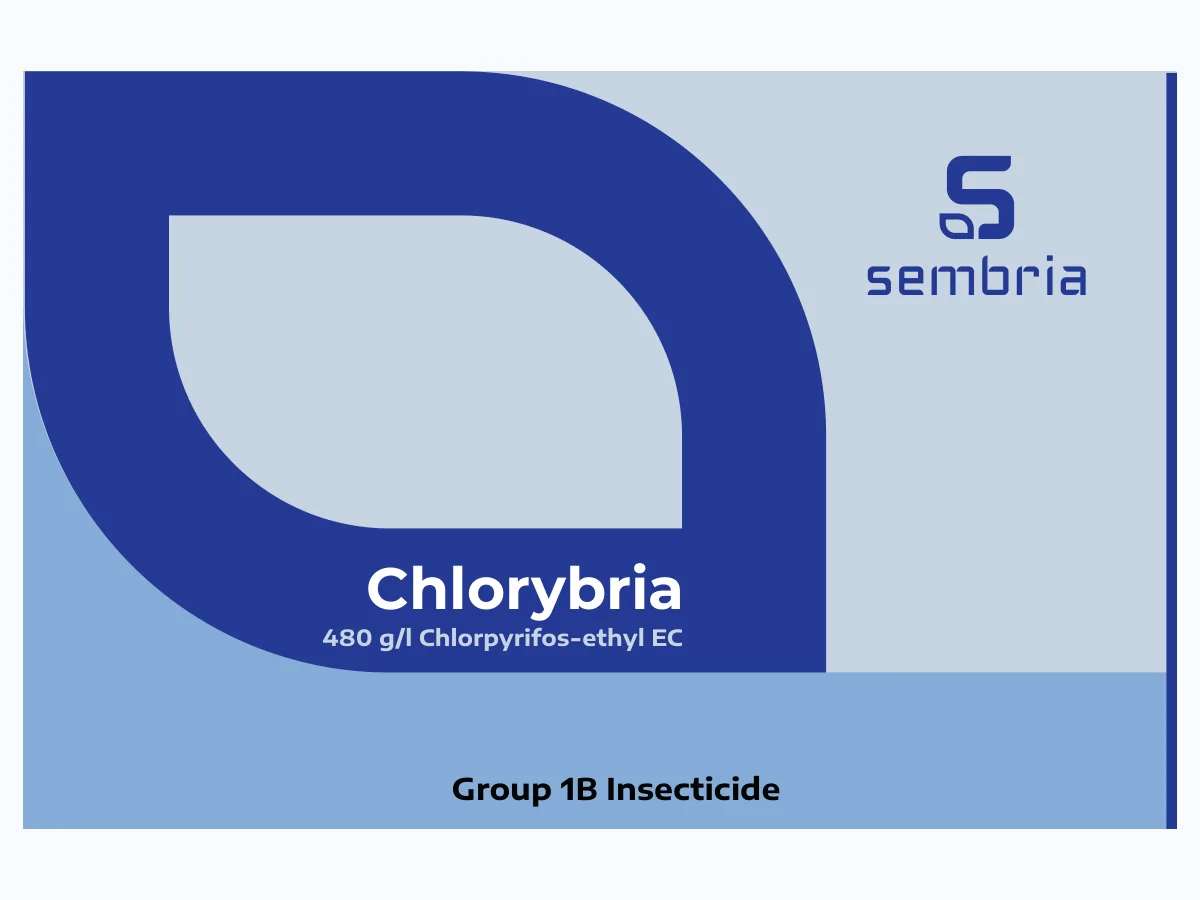
Chlorybria is a high-load organophosphate insecticide based on chlorpyrifos-ethyl at 480 g/l. Its registered pest list is the longest of any product Sembria carries — more than thirty targets across fruit, olive, vine, sugar beet, vegetables, cereals, cotton, corn and pistachio. It is particularly valued where softer chemistry struggles: armoured scale insects under a waxy shield, wood-boring larvae inside the trunk, and soil-dwelling pests such as wireworms and springtails.
Characteristics
- The broadest pest spectrum in the Sembria insecticide portfolio
- Effective on armoured and soft scale insects that resist contact-only products
- Controls wood-boring larvae, soil pests and the full aphid complex
- Registered for both summer and winter (dormant) control programmes on fruit
- Contact, stomach and vapour activity
- High active loading at 480 g/l — low volume per hectare
How it works
Chlorpyrifos-ethyl inhibits acetylcholinesterase at the nerve synapse. Acetylcholine accumulates, nerve firing becomes continuous, and the insect dies of convulsive paralysis. The vapour phase reaches pests under bark and beneath scale covers. IRAC Group 1B.
Dosing
| Crop | Target pest | Dose | PHI (days) |
|---|---|---|---|
| Fruit | Leopard moth / peach tree borer (Zeuzera pyrina) | 200 ml | 14 |
| Fruit | Peach pit scale (Nilotaspis halli), summer control | 150 ml | 14 |
| Fruit | Fall webworm (Hyphantria cunea) | 105 ml | 14 |
| Fruit | Pear lace bug (Stephanitis pyri) | 150 ml | 14 |
| Fruit | Red-skinned apple scale (Epidiaspis leperii), summer control | 100 ml | 14 |
| Fruit | Mulberry scale (Pseudaulacaspis pentagona) | 100 ml | 14 |
| Fruit | Apple clearwing moth (Synanthedon myopaeformis) | 125 ml | 14 |
| Fruit | Codling moth (Cydia pomonella) | 150 ml | 14 |
| Fruit | Two-marked scale (Palaeolecanium bituberculatum) | 150 ml | 14 |
| Fruit | Brown scale (Parthenolecanium corni) | 150 ml | 14 |
| Fruit | San Jose scale (Quadraspidiotus perniciosus) | 150 ml | 14 |
| Fruit | Green apple aphid (Aphis pomi) | 150 ml | 14 |
| Fruit | Rosy apple aphid (Dysaphis plantaginea) | 150 ml | 14 |
| Fruit | Aphid (Dysaphis spp.) | 150 ml | 14 |
| Fruit | Peach-potato aphid (Myzus persicae) | 150 ml | 14 |
| Fruit | Mealy plum aphid (Hyalopterus pruni) | 150 ml | 14 |
| Fruit | Peach trunk aphid (Pterochloroides persicae) | 150 ml | 14 |
| Fruit | Apple leafroller (Archips rosanus) | 100 ml | 14 |
| Fruit | Olive scale (Parlatoria oleae) | 100 ml | 14 |
| Olive | Olive scale (Parlatoria oleae) | 100 ml | 14 |
| Olive | Olive moth (Prays oleae) | 150 ml | 14 |
| Vine | Grape berry moth (Lobesia botrana) | 100 ml | 14 |
| Sugar beet | Soil pests: Collembola, Blaniulus, Agriotes, Agrotis spp. | 150 ml/da | 7 |
| Sugar beet | Leafworms (Spodoptera exigua, Mamestra spp., Plusia gamma) | 200 ml/da | 7 |
| Sugar beet | Beetles (Chaetocnema tibialis, Cleonus spp., Lixus spp.) | 150 ml/da | 7 |
| Vegetables | Onion psyllid (Bactericera tremblayi) | 150 ml/da | 7 |
| Vegetables | Helicoverpa armigera | 180 ml/da | 7 |
| Vegetables | Whitefly (Bemisia tabaci) | 200 ml/da | 7 |
| Vegetables | Diamondback moth (Hellula undalis) | 200 ml/da | 7 |
| Vegetables | Cotton leafworm (Spodoptera littoralis) | 180 ml/da | 7 |
| Vegetables | Colorado potato beetle (Leptinotarsa decemlineata) | 180 ml/da | 7 |
| Corn | Corn earworm (Sesamia nonagrioides) | 180 ml/da, 15-day interval | 7 |
| Corn | European corn borer (Ostrinia nubilalis) | 80 ml/da, 15-day interval | 7 |
| Lentils | Helicoverpa armigera | 150 ml/da | 7 |
| Chickpeas | Helicoverpa armigera | 150 ml/da | 7 |
| Cereals | Wheat midge (Syringopais temperatella) | 100 ml/da | 14 |
| Cereals | Wheat curculio (Zabrus spp.) | 200 ml/da | 14 |
| Cereals | Weevil (Pachytychius hordei) | 250 ml/da | 14 |
| Sunflower | Helicoverpa spp. | 200 ml | 14 |
| Cotton | Cotton leafworm (Spodoptera littoralis) | 180 ml/da | 14 |
| Cotton | Aphid (Aphis gossypii) | 200 ml/da | 14 |
| Pistachio | Black twig borer (Hylesinus vestitus) | 150 ml | 14 |
Doses are indicative. The user is responsible for adjusting the dose to the growth stage of the crop and the conditions of the field. Apply under the guidance of an agricultural technician. Composition, method of application and dose may vary between countries for climatic, technical or legal reasons.
Application
How to apply
Apply with thorough coverage, wetting the underside of leaves and, for scale and borer targets, the trunk and main branches. Do not allow contact with seeds.
Compatibility
Conduct a preliminary compatibility test before mixing.
Always carry out a compatibility test before preparing a tank mixture.
Safety and handling
Very toxic to aquatic life with long-lasting effects. Toxic to fish and to bees — do not apply during flowering and do not contaminate water. Do not allow contact with seeds. Do not re-enter the treated area for 1 day. Collect spillage. No specific antidote — treat symptomatically.
Read the label before use. Do not use at home. Keep away from children, food and animal feed. Use only as recommended and at the recommended dose.
Plant protection product
This page is technical information, not an offer of sale. Availability and registration status vary by territory. Always read and follow the approved product label before use.