Malabria
A broad-spectrum workhorse for field crops and grain stores alike.
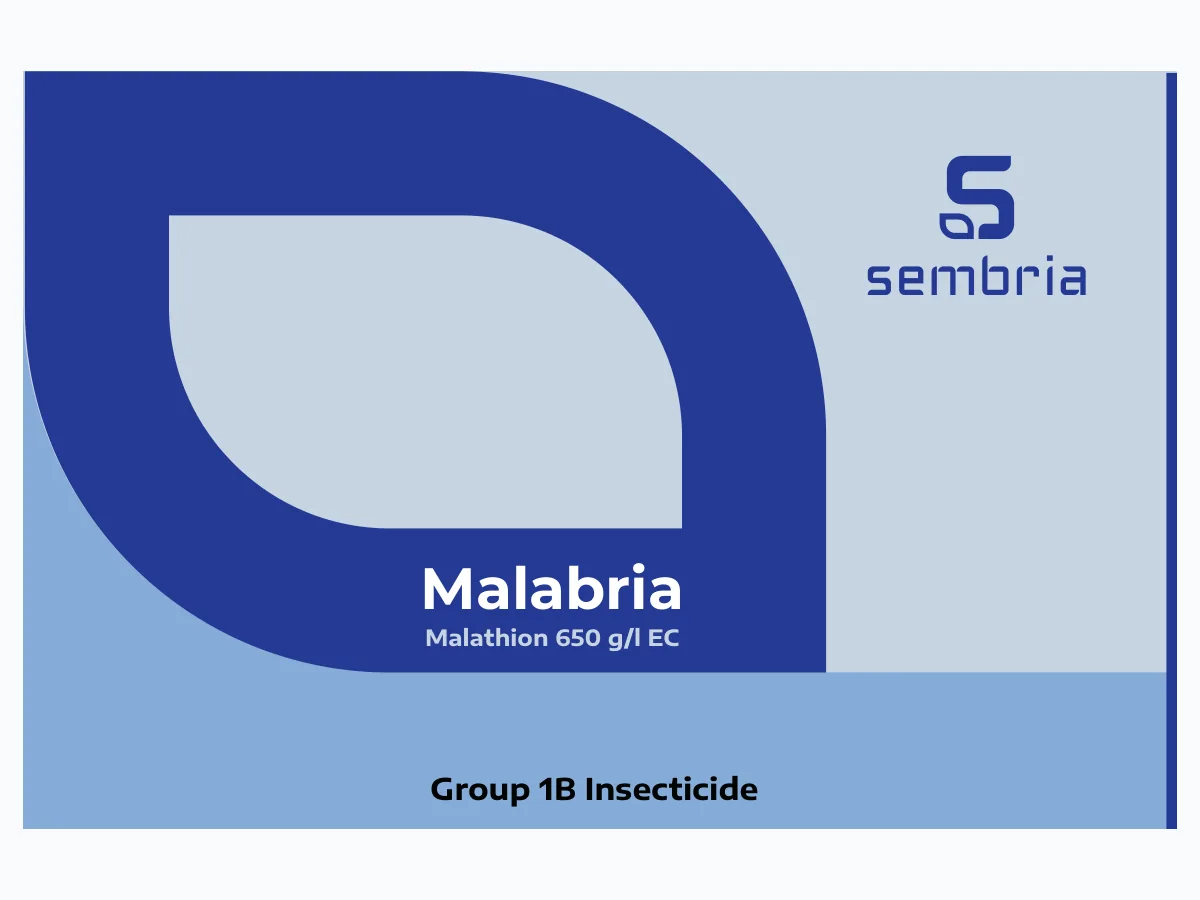
Malabria is a broad-spectrum organophosphate insecticide based on malathion. It covers an unusually wide range of pest types for one product — caterpillars, aphids, leafhoppers, stink bugs, mealybug and weevils — across tomato, bean, corn, cotton, soybean, sesame, apricot, vineyard and poppy. It is also registered for treating empty grain stores before the crop goes in, which makes it a useful dual-purpose product for growers who store their own harvest.
Characteristics
- Very broad pest spectrum from a single product
- Registered for empty-store treatment as well as field use, at 200 ml/100 m2
- Effective on vine mealybug, a pest few products in the range cover
- Contact and stomach action with rapid effect
- Consistent 7-day pre-harvest interval across all field crops
- Long-established chemistry with a well-defined antidote protocol
How it works
Malathion inhibits acetylcholinesterase at the nerve synapse. Acetylcholine accumulates, nerve transmission becomes continuous and the insect dies of convulsive paralysis. It is activated to its more potent oxon form inside the insect, while mammals detoxify it rapidly via carboxylesterase — the basis of its comparatively favourable mammalian safety margin. IRAC Group 1B.
Dosing
| Crop | Target pest | Dose | PHI (days) |
|---|---|---|---|
| Tomato | Tomato fruit borer (Helicoverpa armigera), larva | 200 ml/ha | 7 |
| Bean | Bean pod borer (Etiella zinckenella), larva | 200 ml/ha | 7 |
| Corn | Cotton striped leafworm (Spodoptera exigua), larva | 200 ml/ha | 7 |
| Corn | Warehouse pests | 200 ml/100 m2 | Apply 20-25 days before the crop is placed in storage |
| Cereals and stored grain | Stored product pests | 200 ml/100 m2 | Apply 20-25 days before the crop is placed in storage |
| Apricot | Peach twig borer (Anarsia lineatella), larva | 150 ml/100 L water | 7 |
| Vineyard | Vine mealybug (Planococcus citri), all stages | 150 ml/100 L water | 7 |
| Poppy | Poppy root borer (Ceuthorrhynchus denticulatus), adult | 200 ml/100 L water | 7 |
| Cotton | Cotton striped leafworm (Spodoptera exigua), larva | 250 ml/ha | 7 |
| Cotton | Cotton aphid (Aphis gossypii), adult and nymph | 100 ml/ha | 7 |
| Cotton | Leafhoppers (Empoasca decipiens, Asymmetrasca decedens), adult and nymph | 170 ml/ha | 7 |
| Sesame | Sesame webworm (Antigastra catalaunalis), larva | 100 ml/ha | 7 |
| Soybean | Green stink bug (Nezara viridula), nymph and adult | 170 ml/ha | 7 |
| Soybean | Cotton striped leafworm (Spodoptera exigua), larva | 250 ml/ha | 7 |
Doses are indicative. The user is responsible for adjusting the dose to the growth stage of the crop and the conditions of the field. Apply under the guidance of an agricultural technician. Composition, method of application and dose may vary between countries for climatic, technical or legal reasons.
Application
How to apply
Corn leafworm: check 25 representative plants (5 in a row, 5 rows) and treat at an average of 2 larvae per plant. Cotton aphid: postpone if beneficials are present; treat at 50% infested seedlings after thinning, or 25 aphids per leaf in the field period. Cotton leafhopper: sample 25 leaves from the lower, middle and upper main stem of 25 plants and treat at an average of 10 per leaf. Vine mealybug: two applications — the first when the trunk looks wet and the mealybug starts moving to the green parts (clusters about chickpea size), spraying only infested vines; the second when it moves onto leaves and clusters as the berries begin to ripen. Sesame webworm: treat at 20% infested plants. Soybean stink bug: treat at 6 larvae or 2 newly hatched egg masses per 3 m of row. Empty stores: spray to wet all surfaces.
Compatibility
Do NOT mix with dinitro compounds or with products containing metalaxyl. Conduct a compatibility test before mixing with anything else.
Always carry out a compatibility test before preparing a tank mixture.
Safety and handling
Flammable liquid and vapour. Harmful if swallowed or inhaled; causes skin irritation; may cause allergic skin reactions. Very toxic to aquatic life with long-lasting effects. Toxic to fish and to bees — do not apply during flowering. Inhibits blood cholinesterase. Do not re-enter the treated area for 7 days. Antidotes: ATROPINE SULFATE, PAM and TOXOGONIN, administered by a physician.
Read the label before use. Do not use at home. Keep away from children, food and animal feed. Use only as recommended and at the recommended dose.
Plant protection product
This page is technical information, not an offer of sale. Availability and registration status vary by territory. Always read and follow the approved product label before use.